Dosing and infusion rates

Privigen is a ready-to-use 10% liquid intravenous immunoglobulin (IVIg) with no warming or reconstitution necessary. It should be given by a separate infusion line and not mixed with other intravenous medications. However, Privigen may be diluted with Dextrose Injection, USP (D5W). See the chart below or use the dosing calculator to find the recommended dosage for your patient.

PI
CIDP
Chronic ITP

Recommended dosing and infusion rates for Primary Immunodeficiency (PI)

Dose_Initial-Infusion-Rate_Maintenance-Infusion-Rate

Monitor the patient’s vital signs throughout the infusion. Slow or stop the infusion if adverse reactions occur. If symptoms subside promptly, the infusion may be resumed at a lower rate that is comfortable for the patient. Titrate based on patient tolerability.

For patients at risk of thrombosis, renal dysfunction, or renal failure, administer Privigen at the minimum dose and infusion rate practicable, and discontinue Privigen administration if renal function deteriorates

Recommended dosing and infusion rates for Chronic Immune Thrombocytopenic Purpura (ITP)

Dose_Initial-Infusion-Rate_Maintenance-Infusion-Rate

Monitor the patient’s vital signs throughout the infusion. Slow or stop the infusion if adverse reactions occur. If symptoms subside promptly, the infusion may be resumed at a lower rate that is comfortable for the patient. Titrate based on patient tolerability.

For patients at risk of thrombosis, renal dysfunction, or renal failure, administer Privigen at the minimum dose and infusion rate practicable, and discontinue Privigen administration if renal function deteriorates.
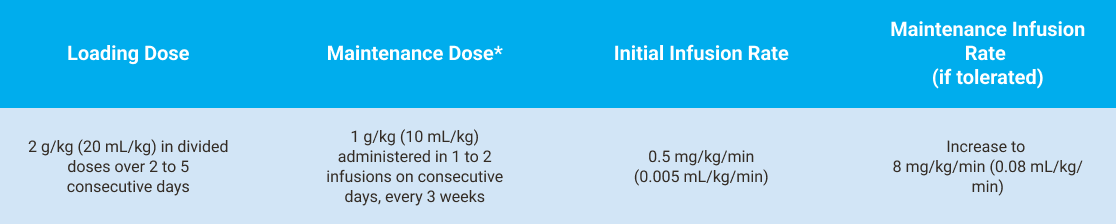
Recommended dosing and infusion rates for Chronic Inflammatory Demyelinating Polyneuropathy (CIDP)

Dose_Initial-Infusion-Rate_Maintenance-Infusion-Rate

Monitor the patient’s vital signs throughout the infusion. Slow or stop the infusion if adverse reactions occur. If symptoms subside promptly, the infusion may be resumed at a lower rate that is comfortable for the patient. Titrate based on patient tolerability.

For patients at risk of thrombosis, renal dysfunction, or renal failure, administer Privigen at the minimum dose and infusion rate practicable, and discontinue Privigen administration if renal function deteriorates.

Per the protocols for the Privigen clinical trials, the initial infusion rate was 0.5 mg/kg/min for each infusion. The rate could then be doubled every 30 minutes up the maximum allowable rate (either 8 mg/kg/min for PI and CIDP or 4 mg/kg/min for ITP) based on patient tolerability and healthcare provider clinical judgement.

Infusion Rate Calculator

Dosing Calculator Step 1 Patient Profile


Loading dose: 2 g/kg (20 mL/kg) in divided doses over 2 to 5 consecutive days
Maintenance dose: 1 g/kg (10 mL/kg) administered in 1 to 2 infusions on consecutive days, every 3 weeks
ITP Dose: 1 g/kg (10 mL/kg) daily for 2 consecutive days
PI Dose: 200–800 mg/kg (2–8 mL/kg) every 3–4 weeks
Dosing Calculator Step 2 Infusion Rate
0.3
min
2.4
max
4.8
max
4.8
max
2.4 mL/kg/h
Initial 0.5 mg/kg/min
(0.005 mL/kg/min)
Maintenance
(as tolerated)
Increase to 4 mg/kg/min
(0.04 mL/kg/min)
Initial 0.5 mg/kg/min
(0.005 mL/kg/min)
Maintenance
(as tolerated)
Increase to 8 mg/kg/min
(0.08 mL/kg/min)
Initial 0.5 mg/kg/min
(0.005 mL/kg/min)
Maintenance
(as tolerated)
Increase to 8 mg/kg/min
(0.08 mL/kg/min)
For patients at risk for renal dysfunction or thrombosis or patients switching from another Ig product, always start at the minimum dose and infusion rate.
Back
Dosing Calculator Step 3 Calculated
Infusion Rate
000 mL/h
Total Dose: mL
Total Infusion Time:
  • Monitor the patient’s vital signs throughout the infusion
  • Slow or stop the infusion if adverse reactions occur. If symptoms subside promptly, the infusion may be resumed at a lower rate that is comfortable for the patient
  • Titrate based on patient tolerability
Back

Please consult the prescribing information for complete dosing and infusion information.

*Maintenance therapy in CIDP has not been studied for periods longer than 6 months. Individualize duration of treatment beyond 6 months based on patient responses.
  • Calculate each daily dose by dividing the total loading dose above by the number of consecutive infusion days (2, 3, 4, or 5).
  • Assess corresponding infusion time by dividing by the number of consecutive infusion days.
  • If you choose to administer the maintenance dose over 2 consecutive days, divide the total dose above by 2 and administer that amount each day.
  • Assess corresponding infusion time by dividing by the number of consecutive infusion days.

Download a PDF

Download a PDF of dosing and infusion rates based on patient weight or use the calculator above to find precise dosing information for each patient.

View and download PDF
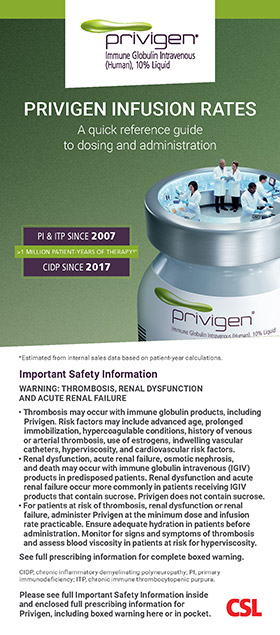
Download the Privigen infusion rates brochure

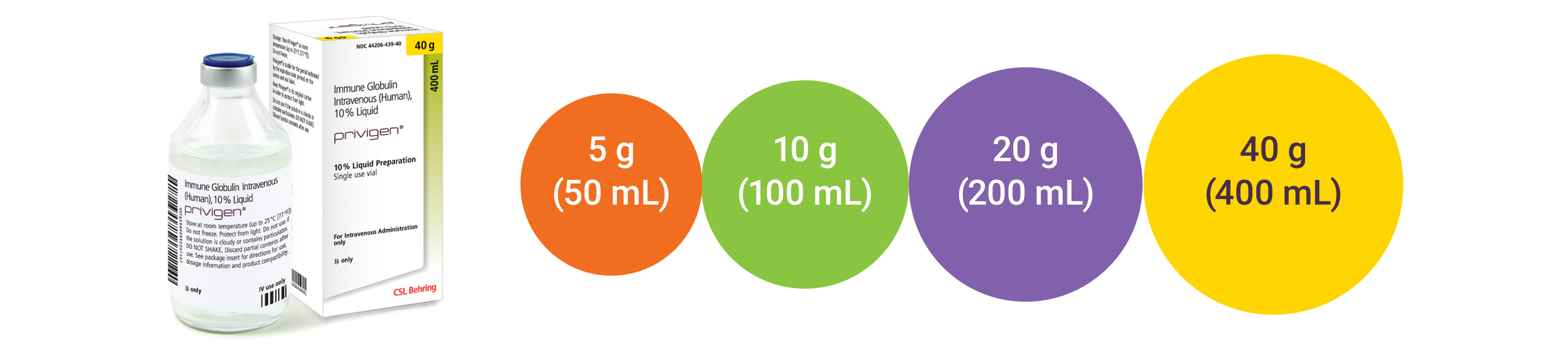
Vial Sizes

  • Multiple vial sizes to minimize waste
  • Has one of the largest vial sizes available among IVIg products
Privigen Vial Dosing Options

Ordering

To order, contact your Group Purchasing Organization (GPO) or distributor, or speak with your CSL Behring sales representative.

Get information regarding ordering, billing, coding, and reimbursement

Privigen Connect can help. It’s your single source for Ig solutions from CSL Behring. Find out more or call 1-877-355-4447, Monday-Friday, 8am to 8pm ET, to speak with an expert.

Starting new patients on Privigen

When starting new patients on Privigen therapy:

  • Start at a slow rate of infusion (e.g., 0.5 mg/kg/min [0.005 mL/kg/min] or less) and gradually increase as tolerated
  • Per the protocols for the Privigen clinical trials, the initial infusion rate was 0.5 mg/kg/min for each infusion. The rate could then be doubled every 30 minutes up the maximum allowable rate (either 8 mg/kg/min for PI and CIDP or 4 mg/kg/min for ITP) based on patient tolerability and healthcare provider clinical judgement
  • Privigen should be administered at the minimum dose and infusion rate practicable in patients judged to be at risk of renal failure, renal dysfunction, or thrombotic events
  • Patients at risk of thrombosis, renal dysfunction, or renal failure should not be volume depleted when initiating intravenous immunoglobulin (IVIg) therapy. Ensure adequate hydration before administering Privigen. Discontinue Privigen administration if renal function deteriorates
  • The patient's vital signs should be monitored carefully throughout the infusion for adverse reactions
  • If adverse reactions occur, the infusion should be stopped or slowed down. If symptoms subside promptly, the infusion may be resumed at a lower rate that is comfortable for the patient
woman consulting with a doctor

The following patients may be at risk of developing systemic reactions (mimicking symptoms of an inflammatory response or infection) on rapid infusion of Privigen (greater than 4 mg/kg/min [0.04 mL/kg/min]): 1) those who have never received Privigen or another IgG product or who have not received it within the past 8 weeks, and 2) those who are switching from another IgG product. These patients should be started at a slow rate of infusion (e.g., 0.5 mg/kg/min [0.005 mL/kg/min] or less) and gradually increase as tolerated.

man consulting with a doctor

Transitioning patients from another Ig product to Privigen

If you are transitioning patients from another Ig product to Privigen:

  • Always start at the minimum rate of infusion (e.g., 0.5 mg/kg/min [0.005 mL/kg/min] or less)
  • The patient's vital signs should be monitored carefully throughout the infusion for adverse reactions
  • If adverse reactions occur, the infusion should be stopped or slowed down. If symptoms subside promptly, the infusion may be resumed at a lower rate that is comfortable for the patient
  • Gradually titrate infusion rate based on patient tolerability

Monitoring patients for adverse reactions

Patients receiving Privigen should be observed and monitored carefully throughout the infusion. If adverse reactions occur, the infusion should be slowed or stopped until the symptoms subside. If symptoms subside promptly, the infusion may be resumed at a lower rate that is comfortable for the patient. The following are some other things to keep in mind:

  • Thrombosis Warning

    Thrombosis may occur with immune globulin products including Privigen. Risk factors may include: advanced age, prolonged immobilization, hypercoagulable conditions, history of venous or arterial thrombosis, use of estrogens, indwelling central vascular catheters, hyperviscosity, and cardiovascular risk factors. Thrombosis may occur in the absence of known risk factors. Monitor for signs and symptoms of thrombosis and assess blood viscosity in patients at risk for hyperviscosity.

  • Renal Failure Warning

Renal dysfunction, acute renal failure, osmotic nephrosis, and death may occur with IVIg products in predisposed patients. Patients predisposed to renal dysfunction include those with any degree of pre-existing renal insufficiency, diabetes mellitus, age greater than 65, volume depletion, sepsis, paraproteinemia, or patients receiving known nephrotoxic drugs.

Renal dysfunction and acute renal failure occur more commonly in patients receiving IVIg products containing sucrose. Privigen does not contain sucrose.

For patients at risk of thrombosis, renal dysfunction or failure, administer Privigen at the minimum dose and infusion rate practicable. Ensure adequate hydration in patients before administration. Monitor for signs and symptoms of thrombosis and assess blood viscosity in patients at risk for hyperviscosity.

Monitor renal function, including blood urea nitrogen and serum creatinine before the initial infusion of Privigen, and urine output in patients at risk of developing acute renal failure.

  • Therapy Contraindications

Privigen is contraindicated in patients with history of anaphylactic or severe systemic reaction to human immune globulin, in patients with hyperprolinemia, and in IgA-deficient patients with antibodies to IgA and history of hypersensitivity.

  • Warnings and Precautions
    • Severe hypersensitivity reactions may occur. In case of hypersensitivity, discontinue the Privigen infusion immediately and institute appropriate treatment. Medications such as epinephrine should be available for immediate treatment of acute hypersensitivity reactions
    • Immunoglobulin A (IgA)-deficient patients with antibodies to IgA are at greater risk of developing severe hypersensitivity and anaphylactic reactions. Privigen contains a trace amount of IgA (≤25 mcg/mL)
    • Hyperproteinemia, increased serum viscosity, and hyponatremia may occur in patients receiving IVIg therapy
    • Aseptic meningitis syndrome (AMS) may occur more frequently in association with high doses (2 g/kg) and/or rapid infusion of IVIg. AMS usually begins within several hours to 2 days following IVIg treatment. Discontinuation of treatment has resulted in remission of AMS within several days without sequelae
    • Hemolysis can develop subsequent to Privigen treatments due to enhanced red blood cell sequestration. Monitor patients for hemolysis and hemolytic anemia. The following risk factors may be associated with the development of hemolysis: high doses (e.g., ≥2 g/kg), given either as a single administration or divided over several days, and non-O blood group
    • Elevations of systolic and/or diastolic blood pressure (including cases of hypertensive urgency) have been observed during/shortly following Privigen infusion. These blood pressure elevations were resolved or significantly improved within hours with either observation alone or changes in oral anti-hypertensive therapy. Check patients for a history of hypertension and/or current use of antihypertensive medication and monitor blood pressure prior, during, and following Privigen infusion
    • Monitor patients for pulmonary adverse reactions (transfusion-related acute lung injury [TRALI]). Symptoms typically appear within 1 to 6 hours following treatment
    • Volume overload: Carefully consider the relative risks and benefits before prescribing the high dose regimen (for chronic ITP and CIDP) in patients at increased risk of thrombosis, hemolysis, acute kidney injury, or volume overload
    • Because Privigen is made from human blood, it may carry a risk of transmitting infectious agents (eg, viruses, the variant Creutzfeldt Jakob disease [vCJD] agent and, theoretically, the Creutzfeldt Jakob disease [CJD] agent). The risk of infectious agent transmission has been reduced by screening plasma donors for prior exposure to certain viruses, testing for the presence of certain current virus infections, and including virus inactivation/removal steps in the manufacturing process for Privigen
    • Various passively transferred antibodies in immunoglobulin preparations may lead to misinterpretation of the results of serological testing
    • The passive transfer of antibodies with immunoglobulin administration may interfere with the response to live virus vaccines such as measles, mumps, rubella, and varicella

Please see Important Safety Information and full prescribing information.

You are now leaving the current website.

Do you want to continue?