Proline interacts with hydrophobic groups in the IgG molecule, thereby reducing protein-protein association and dimerization; in other words, it stabilizes IgG molecules as monomers.2 The images below show dimer formation in IgG solutions with proline and without proline.
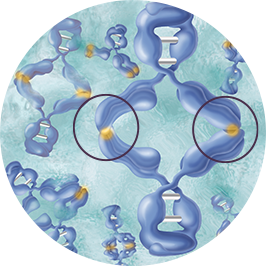
In solution, IgG molecules (shown in blue) reversibly bind to each other (circled).2
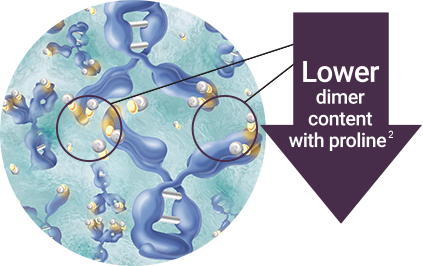
Proline may shield IgG molecules from binding together.2
Privigen may be an option for patients with latex allergy, sensitivity to preservatives, or those who need to limit their sugar intake

See how Privigen did in clinical studies
View the studiesReferences: 1. Cramer M, Frei R, Sebald A, Maeder M. Stability over 36 months of new liquid 10% polyclonial immunoglobulin product (IgPro10. Privigen®) stabilized with L-proline. Vox Sang. 2009;96(3):219-225. 2. Bolli R, Woodtli K, Bärtschi M, Höfferer L, Lerch P. L-Proline reduces IgG dimer content and enhances the stability of intravenous immunoglobulin (IVIG) solutions. Biological. 2010;38(1):150-157. 3. Hagan JB, Fasano MB, Spector S, et al. Efficacy and safety of new 20% immunoglobulin preparation for subcutaneous administration, IgPro20, in patients with primary immunodeficiency. J Clin Immunol. 2010;30(5):734-745.